44 Years, Six Concepts, and the One Question the Village Never Asked
Survey #2 closes July 31. Six concepts for the post office site, six price tags — and a set of cost dials that do not quite say what the renderings imply. Here is the whole decision, and how it got this late.
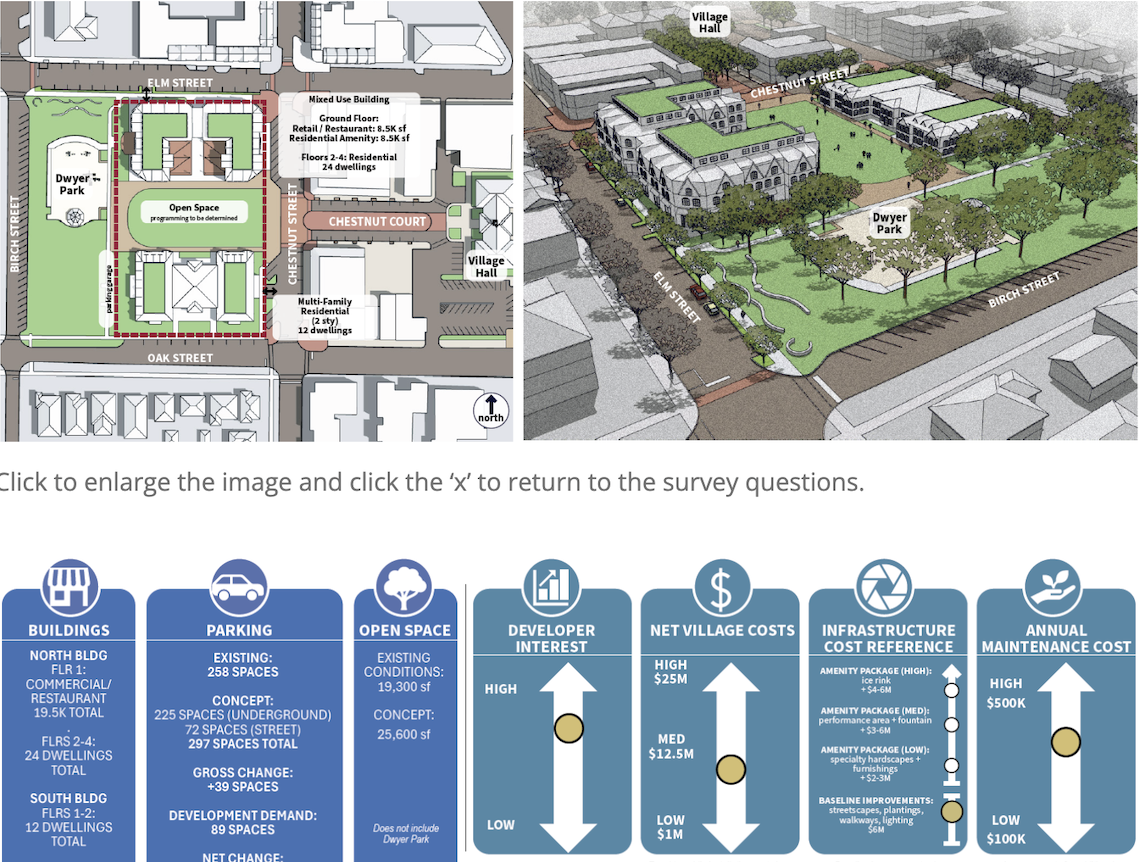
The Village bought 512 Chestnut Street in 1982. The 1986 comprehensive plan identified the parcel as a redevelopment opportunity. And in 2008, Ed Woodbury — then the village president — told Better Magazine that the Village had bought the land intending it to become a commercial development. Fast forward: it has been home to a post office and a parking lot ever since, and today it is a lawn.
What follows is a record of blue sky ideas, commissioned plans, proposals, debates and studies. An ad-hoc committee formed around 2005 to plan for the end of the postal lease. A push to move the library there gathered momentum in 2007. The Village adopted a Downtown Master Plan in November 2016 after a year-long community process, and the Winnetka Futures 2040 comprehensive plan in April 2023. In 2022, then-Village President Chris Rintz proposed a public plaza with gathering space and room for small concerts and markets, invoking the village’s 1921 comprehensive plan by architect Edward Bennett; all eight residents who spoke that night supported it. In 2024, staff commissioned conceptual plaza designs — and then, per the Council’s own October 2025 packet, no further discussion or action occurred.
At that October 2025 session, trustees were given two ways forward: hire a design firm to draw a gathering space, or hire a consultant to run public engagement. They chose engagement. The postal service moved out in December; in March the Council approved a $585,000 demolition contract on the consent agenda; the building came down in the spring. Which brings us to a nine-page survey and a July 31 deadline.
Please take the survey at: www.helloinput.org/winnetka-post-office-site. Be heard. Do not let the few and the loud speak for the village. But before you click, the whole ballot on one page:
The six choices, side by side
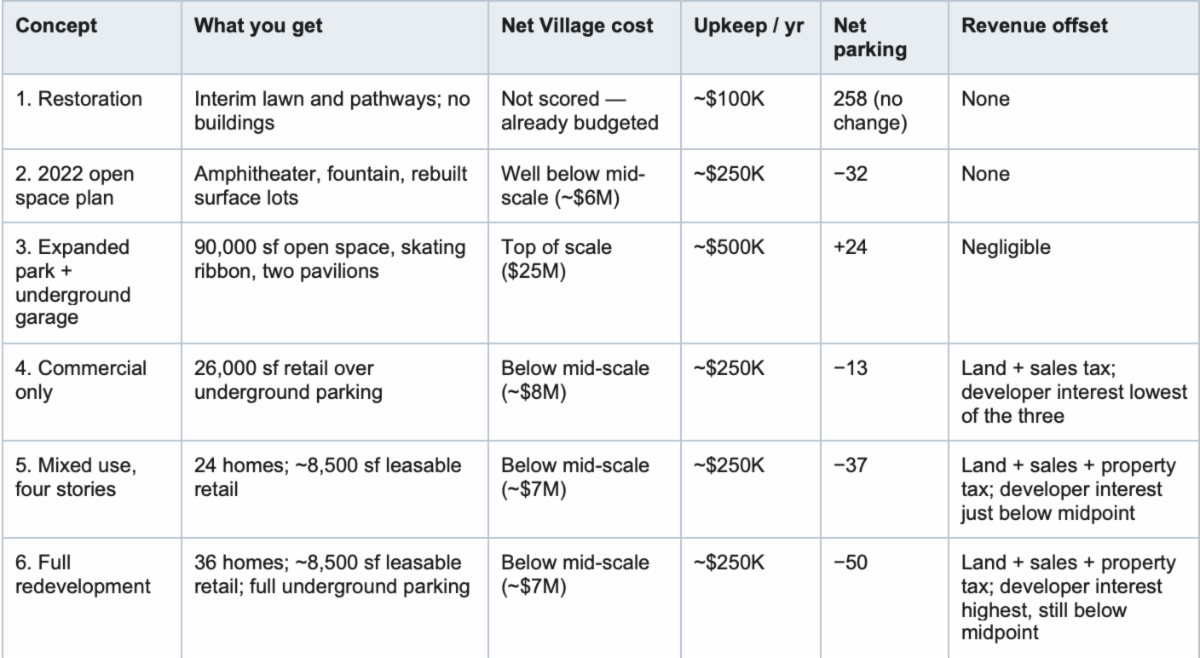
Cost and maintenance figures are the Village’s and Teska’s own conceptual estimates. Dollar approximations are Our Town Winnetka’s reading of dials that print only their endpoints.
How to read the money
Two costs matter most.
Net Village cost is what the public installation would cost minus the value of land generated by private development — so the only thing that offsets Village cost is a developer. No developer, no offset. Measured against the Village’s entire 2026 capital plan of $39.5 million, Concept 3 alone would equal roughly two-thirds of a full year of Village-wide capital spending.
Annual maintenance runs from $100,000 to $500,000 a year, and unlike construction, it never ends -- over 30 years, that spread is the difference between $3 million and $15 million.
Then the fine print under every dollar figure. The estimates, however, assume baseline infrastructure only — about $6 million of streetscapes, plantings, walkways and lighting. They exclude the amenity packages listed beside them: hardscapes $2–3 million, a performance area and fountain $3–6 million, an ice feature $4–6 million. Those are precisely the features Survey #1 respondents ranked highest. On five of six concepts, they are not in the price. One further caution: the dials carry no figures. Only Concept 3 sits at a labeled position; every other dollar amount here, including ours, is an inference.
What the six concepts actually do
Concept 1 is already built and scored N/A — no buildings, no revenue, no change.
Concept 2 revives the 2022 plaza and reads as the lowest net cost of any scored concept — but with no developer, every dollar is a public dollar. That money has to come from somewhere: the same capital plan already carrying $18.4 million of Willow Road reconstruction, or debt, or a new revenue source. The Village has not said which.
Concept 3 is the showpiece and the only concept that adds net parking — and the only one pegged at the ceiling of both dials at once: $25 million to build, $500,000 a year to keep, with essentially nothing on the offset side. It is the most expensive thing on the survey, twice over.
Concepts 4 through 6 let private development carry the load, and all three read below the midpoint on net cost — cheaper, on the Village’s own dials, than the renderings suggest.
Concept 4 carries the largest retail program, 26,000 square feet — and whether the village wants that much is a fair question, though Survey #1 respondents did rank additional commercial uses their second priority overall.
Concepts 5 and 6 add 24 and 36 homes, but their 19,500-square-foot ground floors hold only about 8,500 square feet of leasable retail or restaurants.
And the cards are more sobering than the pictures: no concept is rated above the midpoint for developer interest. Concept 6 comes closest and still reads slightly low.
The option that has never been on the table
In 44 years, the Village has formed a committee, commissioned plans, hired designers, lost a design firm, hired an engagement consultant and run two surveys. What the documented record does not show is the Village ever asking the market what this land is worth.
In October 2025 the two options put before trustees were a design firm or an engagement firm. A request for proposals to developers was not among them — and every concept on this ballot that returns money to taxpayers depends on a developer who has never been formally invited to bid.
The 2022 plaza drew support from a very small and vocal group — only eight speakers. This is not the voice of the community. The 2025 turn toward public engagement drew on caucus survey results. None of that makes deliberation over a permanent public asset a failure in itself, and a bad 40-year deal would be worse than a slow one.
Trustees have been candid about the tension, too. Rob Apatoff, who backed the 2022 plaza, last October called the parcel the last open space the village has, while adding that he was not looking for a $40 million plan. Village President Bob Dearborn said cost would be a constraint and that the Council needed to go back to the public.
That is the case for asking residents first. But it is also why the missing question matters. An appraisal would tell the Village what the dirt is worth. Only a solicitation tells it what a developer would actually pay given the parking it must replace, the public space it wants and the entitlements it would grant — and that is the number every offset on this ballot depends on. The Village has never asked for it.
It is important that you be heard.
What the village has actually said about building
This is where the record is more interesting: Eight people endorsed the plaza in 2022. Survey #1 drew roughly 1,257 responses — and when the larger group was asked, the unanimity vanished.
Asked to rank residential uses, 570 respondents put “no residential” first. That is the single largest bloc in the survey and it should not be waved away. But 408 put mixed use first, citing the need for senior and empty-nester housing. And asked about community priorities overall, respondents ranked a public gathering space first and additional commercial uses second — with restaurants and dining, shopping and retail, and coffee shops and cafes the three most-wanted commercial types.
Read together, that is not a village that wants nothing built. It is a village that wants a gathering place, restaurants and coffee shops, and is genuinely split on homes. Every concept on this ballot except restoration delivers some version of the first two. The fight is over the third — and over who pays for any of it.
Eight people in a room agreed. About 1,257 survey respondents did not. Whichever way this goes, the Council should be able to say plainly which of those two it is listening to.
What Concept 6 delivers (pictured at the top of this article)
Concept 6 is the only one that does four things at once.
- Housing choice: 36 attached homes — the senior and empty-nester option Survey #1 respondents who favored mixed use named directly.
- A land transaction, either way: the Village can sell outright or ground-lease, keep title, and take recurring rent — a choice it has and has not publicly discussed.
- Two tax lines, not one: retail generates sales tax, including the 1% home-rule tax adopted this year, while 36 homes generate property tax for the Village, District 36 and New Trier in perpetuity. Concepts 1 through 3 generate neither.
- A district, not a parcel: with One Winnetka delivering at Lincoln and Elm, a redeveloped site would anchor both ends of Elm Street.
Each carries a condition. The homes are market-rate unless Council negotiates otherwise. A land sale is worth whatever a developer will pay, and no offer exists. Sales tax requires leased storefronts. And 570 Survey #1 respondents ranked “no residential” first — not a rounding error, and no revenue table will argue them out of it.
Before you answer
The survey is not neutral. Concepts 2 through 6 are asked whether they provide “enough community value to justify moving forward.” Concept 1 is asked whether it “should be the long-term vision,” and its stem recites its advantages — no new funding, no parking lost. So ask four things:
- Can the Village build it without new debt or new taxes? Against a $39.5 million capital plan, a $25 million concept is not a line item. It is a program.
- Is there a buyer, or a partner to lease the land? If the offset depends on a developer, the developer-interest dial is not a detail. It is the whole business case — and it has never been tested.
- Can we carry the maintenance line forever? Every concept except restoration at least doubles it.
- What is your parking tolerance? The options run from +24 to −50 net spaces. Pick your number before the renderings pick it for you.
And one thing to watch after July 31, because it is the real test of this exercise. It is not clear what the Village will do with the answers — whether a concept must clear some threshold of support, whether the crosstabs and written comments will be published in full, or whether a preferred concept will be tested against the market before it is adopted. In 2022 the Council acted on the input of eight speakers. In 2026 it will hold thousands of responses and a real split. Ask your trustees now, while the survey is still open, which of those governs — and get the answer on the record.
Doing nothing is on this ballot too, and it has a price: roughly $100,000 a year, forever, and whatever a developer would have paid for the land — a number nobody has ever asked for. After 44 years, that is worth saying plainly. The status quo is not the absence of a decision. It is one.
WHERE OTW COMES OUT
Everything above is the record. This is our opinion, set apart so you can review it -- take what you wish, and leave the rest.
We favor Concept 5 or Concept 6.
Not because a park is a bad idea — residents ranked a public gathering space their top priority, and both concepts include one. Concepts 4, 5 and 6 are the only options that put someone other than the taxpayer behind it. We prefer 5 and 6 over 4 because they carry two tax lines instead of one — sales tax and property tax in perpetuity, where Concepts 1 through 3 generate neither — and because they add the senior and empty-nester housing 408 respondents asked for without asking the village to absorb 26,000 square feet of retail. Between the two, Concept 6 is the better long-term deal and Concept 5 the easier lift on parking.
The 570 residents who ranked "no residential" first are a large and real part of this village, and they are not wrong to want what they want. They are entitled to lose an argument, not to be pretended out of existence.
One caveat on ourselves: we favor 5 and 6 on the Village's dials, not on a bid. Issue the RFP. Let a real offer correct us.
As a final note: the survey closes Friday, July 31, at www.helloinput.org/winnetka-post-office-site. Please do not delay — be heard.
Published by Our Town Winnetka · Our Town. Our Future. Your Voice.
Sources: Village of Winnetka / Teska Associates, Post Office Site Community Survey #2 concept cards, July 2026; Village of Winnetka 2026 Capital Plan; Village Council study session materials, October 2025; The Record North Shore; Better Magazine, March 2008.