A Longer, Less Predictable Path Through Village Hall
An Our Town Winnetka examination of how layered review windows, added boards, and rising discretion have made building, renovating, and opening a business slower and costlier — and how the village compares with its neighbors.
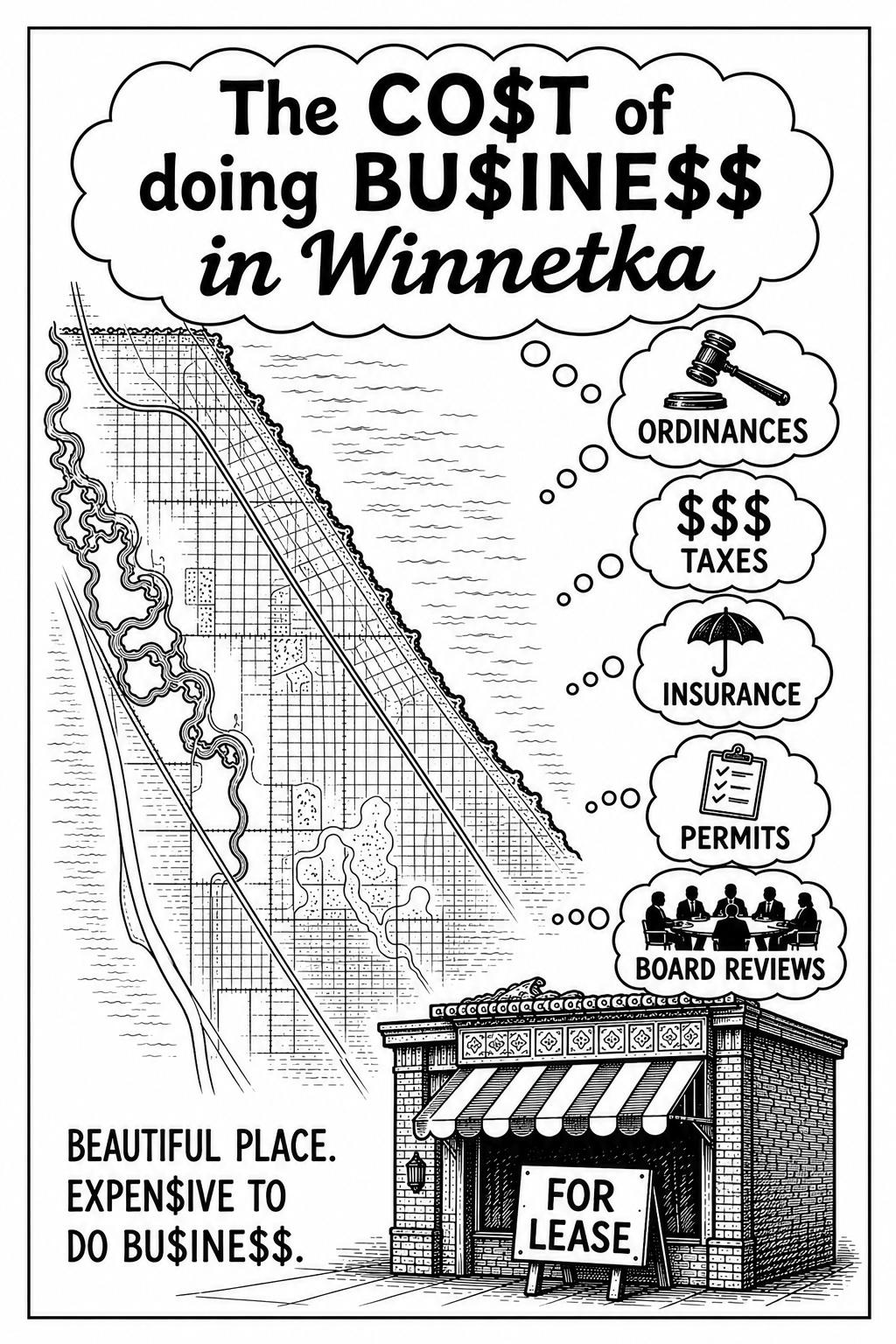
Ask anyone who has tried to renovate a kitchen, rebuild a staircase or open a storefront in Winnetka over the last five years, and you will hear a version of the same sentence: it took longer and cost more than anyone told me it would.
That frustration is not imaginary, and it is not simply the grumbling of people who dislike rules. Winnetka has, by deliberate choice, layered new ordinances, longer review windows and additional discretionary bodies on top of an already careful permitting culture — but good intentions carry a price, increasingly measured in months of delay, legal exposure and carrying costs borne by residents and businesses.
This is not a case against protecting what makes Winnetka, Winnetka; it is a case for honesty about the trade-offs, and for asking why several neighboring villages move faster. The pattern comes down to the same three things — too many sequential reviews, too much discretion, and too little predictability. Consider two stories — one a homeowner's, one a business's.
More gates than most towns nearby
Winnetka's approvals run through more gates than most towns nearby. Depending on the project, an applicant may pass through Community Development staff, the Design Review Board, the Plan Commission, the Zoning Board of Appeals and the Landmark Preservation Commission before reaching the Village Council, which holds final say. That structure is not a matter of interpretation.
A special-use permit is outside the permitted right. It is not triggered by the size or cost of the project but by classification. For many commercial uses, that is the baseline path just to open a door. Each body meets on its own schedule; each can send an applicant back. Special-use permits themselves are standard; what varies between towns is how many ordinary businesses and residents are forced through them, and how predictable they are.
Every North Shore village cares about design, trees, and teardowns — so the real differentiator is time: every extra month is another month of taxes, insurance, financing and idle-site upkeep the owner keeps paying.
Winnetka publishes no target turnaround an applicant can plan around. That unpredictability is itself a cost: when Kenilworth commits to roughly 48 hours and Wilmette to 10 business days, owners can schedule with confidence. In Winnetka, it depends on the calendar of five bodies.
The homeowner's story: a delay that doubled
Moving to strengthen preservation, on March 16 the Village Council adopted Ordinance MC-2-2021, replacing a modest 60-day demolition delay with a potential 270-day delay for any home deemed historically or architecturally significant.
The most telling number is one the Village itself published. The review timeline ran 150 to 180 days before the ordinance and 300 to 330 days after — a full construction season. The government's own paperwork concedes the wait has doubled. And the delay is not free: an owner keeps carrying the property while separately paying for the required impact study, a preservation-consultant fee the Village does not set.
The preservation goal is legitimate. But a delay that doubles turns a policy debate into a recurring bill paid by whoever holds the deed.
The business's story: discretion downtown
On the commercial side, the problem is less how long a form sits in a queue than discretion: locating even an ordinary, wanted business downtown often means running a multi-board gauntlet whose outcome no one can predict. Consider two episodes, four years apart.
In 2021, Coldwell Banker sought a special-use permit for a prime corner at 538 Chestnut Street, and responded to the commission's negative feedback. It walked away not over rent or market, but over the review.
Then, in early 2026, the same dynamic played out inside the town's most sought-after new building. One Winnetka had at last leased all six ground-floor spaces. Yet each tenant still had to clear special-use review, several arriving with negative recommendations. Solidcore, a national fitness studio, came with a 5–3 negative Plan Commission recommendation; the Council declined to vote in February, sent it back for revised parking, then approved it. DUET, an audiology clinic, cleared the Council only 4–2 in April, over another negative recommendation and a dispute about whether staff had classified the use correctly, since hearing-aid offices are permitted by right.
The tenor of those hearings comes through in the officials' own words — "We'd like to see this business in town" — and the Village pressed that preference tenant by tenant, questioning each service and dining use as it came before the Council. But the overlay presumes the market has thinned, against a 2024 JLL study finding that service businesses now lease more space than goods retailers: contesting the market's answer one applicant at a time, and leaving the next landlord to guess whether a signed lease will survive review.
Not every trustee was satisfied. Some trustees (Dalman, Albinson) welcomed Solidcore, while others (Apatoff, Handler) wanted retail, pointing to a recent Winnetka Caucus Survey — in which only 114 respondents wanted fitness studios, though those, too, are service uses, not goods retail. That very split is the point: nobody was hostile to the business, yet a willing tenant's fate turned on an unpredictable debate about tenant type.
The vacancy argument that surfaced described a single district, West Elm — expressly called the lowest in the village — and Winnetka publishes no regular, transparent vacancy study an outsider can check. Other villages do regularly publish their rates and methodology. The commercial case does not rest on it: the discretion problem, documented in the Village's own process and in named applicants who withdrew or were sent back, stands regardless of how full the storefronts are today.
The bottom line
Strip away the individual cases and one conclusion remains for both homeowners and business owners: it has become slower, costlier and less predictable to build, renovate, or open a business in Winnetka — more boards, more steps, and less of the published predictability that Wilmette, Glencoe, Northfield, and Kenilworth already offer.
The cost is not only to those residents and entrepreneurs. When projects stall or walk away, the Village forgoes revenue while it still funds the review apparatus. Bureaucracy meant to protect Winnetka can quietly starve the budget that funds it.
None of this argues against protecting the historic streetscape or the character residents treasure. It argues for counting the cost, publishing the timelines, and clearing a single accountable path through Village Hall. On permitting, Winnetka deserves a Village Hall that moves as thoughtfully, and as quickly, as the people who build here.
Join Our Team
Beyond these frequent emails, we are now seeking residents to join our team:
- Residents who are willing to attend our various Village Council, Historic Preservation, Zoning Board of Appeals and Winnetka Park District meetings to speak their minds for their fellow citizens — and share their observations back to OTW.
- Residents who are open to hosting a coffee at their home to discuss the key issues with fellow residents and bring the insights and summary points back to OTW.
- Residents who have a story worth sharing through our newsletter — where a neighbor needs help navigating local permitting, whether for a personal residence or a local business.
Sources & notes
Winnetka permit-time figures are the Village's own published estimates. Routine permit fees across these villages are broadly comparable and valuation-based; the dollar figures cited are illustrative carrying-cost estimates, not village-published data. Sources include the Village of Winnetka Special Use Permit application packet and Village Code Title 17 (C-2 General Retail Commercial District and C-2 Commercial Overlay); Ordinance MC-2-2021 and the Village's published 150–180 / 300–330-day demolition-review estimates; reporting by The Record North Shore on the Coldwell Banker withdrawal at 538 Chestnut (June 2021) and the Solidcore and DUET special-use reviews at One Winnetka (Feb.–Apr. 2026), including Trustee Apatoff's remarks (March 5, 2026) and the Caucus Survey figures cited by Trustee Handler; One Winnetka final approval (Jan. 2025) and leasing (Oct. 2025); the 2024 JLL study cited on the record by the One Winnetka developer (a national trend, not a Winnetka figure); and the comparative practices of Wilmette, Glencoe, Kenilworth and Northfield planning and review bodies.