Winnetka Finally Has a 20-Year Capital Plan. Now It Needs a Five-Year Promise.
The May 12 study session was an honest start; the real test is whether the Council turns direction into commitment.
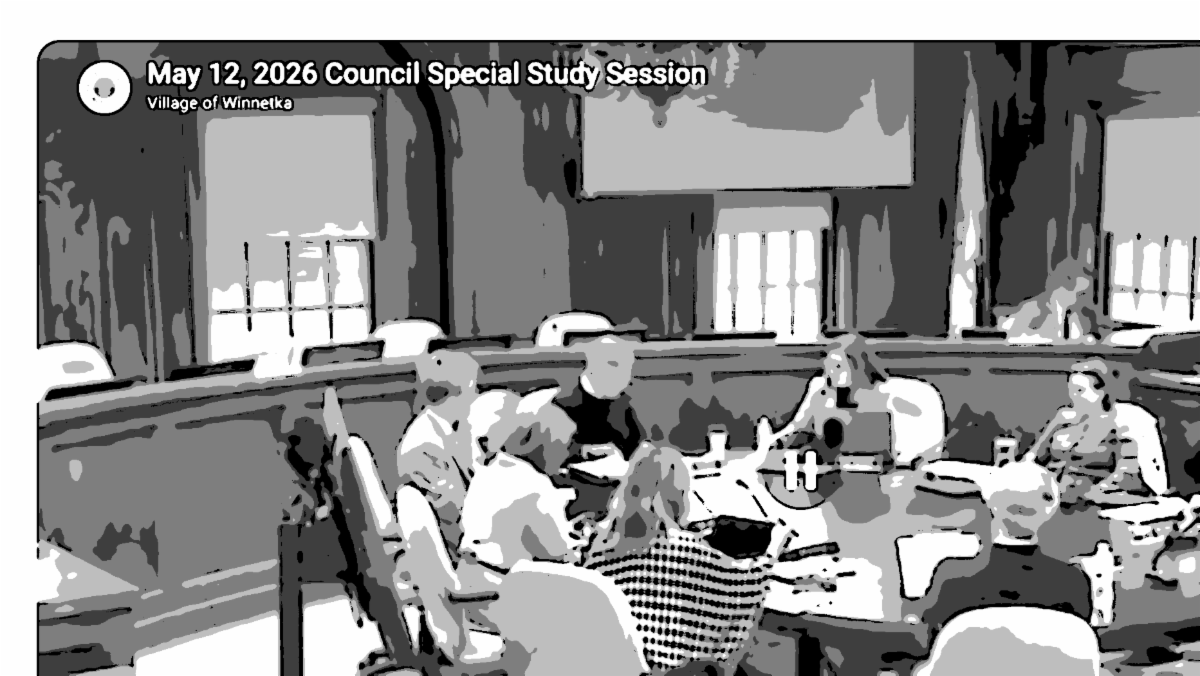
The May 12 study session was an honest start. The real test is whether the Council turns direction into commitment — and a look across our own borders shows what is at stake.
Watch the study session: YouTube video of the May 12 Council session
A First, Three Decades Overdue: Inside the May 12 Study Session
On May 12, the Village Council reviewed something routine in most North Shore towns but a first in Winnetka: a long-range capital plan, roughly three decades overdue. Winnetka CFO Tim Sloth, working with new Village Manager Kristin Kazenas, walked the Council through a 20-year forecast — more than $600 million in capital needs across all funds, with gaps of $66 million to $87 million depending on a pending FEMA stormwater grant.
For the first time, every deferred obligation — streets, water mains, sewers, stormwater, electric — sits in one document, on one timeline, with cost estimates attached.
The model Sloth proposes is standard: forecast long, plan medium, commit short, update annually.
The AAA bond rating is real, but it is not a reward for governing one budget at a time — plenty of AAA towns issue tranche debt against long-range plans.
Sloth was candid about the limits: "we don't know what we don't know." The forecast is directional, the floor of what staff can see today.
The Major Funds:
- General Fund — $110M, led by $52M in streets and sidewalks and a fleet cycle nearing $28M.
- Electric Fund — $17M gap, anchored by a 10-MW thermal project plus $58M in distribution capital.
- Business District Vitalization — $34.1M revenue, but front-loaded streetscape work opens an $11.9M cash-flow gap.
- Eastern Stormwater — $93M placeholder; with Western Stormwater, the stormwater gap runs $21M–$42M.
It adds up to more deferred capital than any single budget can absorb.
The question is no longer whether to plan — but what the Council will commit to — and how long residents must wait.
We know Council can execute when there is a crisis — see 2008 west side floods as the most glaring example — and that still took a decade to get done.
From a 20-Year Forecast to a 5-Year Promise
The forecast makes headlines — yet, accountability lives in a 3-to-5-year funded budget.
On May 12 the Council backed a shift from strict pay-as-you-go toward strategic tranche debt, with a guardrail keeping debt below the $60M threshold Speer Financial ties to the AAA rating.
Near-term commitments include:
- Western Stormwater construction — contingent on a $21.2M FEMA grant
- Advanced Metering — completion in 2027
- The thermal plant — $17M bond in 2028
- A $2M fire engine
- Hubbard Woods and Indian Hill engineering
- The Green Bay Trail project
- Willow Road construction — about 70% federally reimbursed
Identified Revenue Opportunities:
- A levy capturing CPI and new construction
- Stormwater fees rising from $22.92 to $35.62 over seven years
- Water-sewer steps down to 4.5% by 2034
- $36M–$49M in total debt issuance
Three tests will show whether execution matches the framework.
- First, the FEMA decision on the $21.2M Western grant, expected this year; it swings the gap by $21M and decides whether the west side waits seven years or fifteen-plus. Residents deserve a published contingency plan for either outcome.
- Second, the Hubbard Woods Phase I engineering report, due fall 2026 — the first real estimate against a $10.5M placeholder and the basis for an IDOT transfer negotiation.
- Third, and most important, the October 2026 budget, when the framework first feeds the annual process.
The 5-year Capital Improvement Plan it produces is, in staff's words, the residents' commitment document. Beyond five years is direction; the five-year window is a promise.
Two levers deserve scrutiny first:
- Impact fees, which Winnetka still lacks
- Coordinating capital peaks with District 36, the Park District, the Library, and New Trier
Both levers demand progress this summer and real numbers before the October budget, not as ideas to study further.
While Winnetka Studied, Its Neighbors Built
Three nearby villages faced the same problem and chose to commit.
- Wilmette approved its Neighborhood Storage Project in 2018 and finished by 2023 — about $65M for nearly 14M gallons of underground storage and west-side protection raised from 71 to 98 percent, funded by a stormwater fee and bonds.
- Glencoe never waited for a crisis: it runs a standing 10-Year Community Investment Program — the very model Winnetka just unveiled as a first — and is pulling 1940s cast-iron mains this year.
- Kenilworth, a fifth of Winnetka's size, built separated storm sewers, detention, and permeable "green streets," aided by an MWRD partnership that reimburses Cook County towns for stormwater work. Winnetka sits in the same district; residents may fairly ask whether it is pursuing those dollars or leaving them on the table.
Sources: Village of Winnetka and the May 12 staff presentation; Wilmette, Glencoe, and Kenilworth village documents; The Record North Shore; Metropolitan Water Reclamation District. None is a flawless template — Wilmette's project drew a lawsuit from homeowners outside its scope. But the pattern is the same: decide, fund, build on a timeline residents can see.
Two Priorities That Will Define the Plan
The 3-5 year plan will be judged on two issues that are interconnected, yet share one long standing community scar: an east side that floods and a lakefront residents wish to use, yet cannot.
Priority One: East-Side Stormwater
"Deferred capital" is abstract — until it comes up through your floor drain.
Winnetka's own emergency files catalog 100-year storms in 2008, 2011, and 2013. Each one overwhelmed the sewers. Each one pushed stormwater into living rooms and basements.
CBS Chicago found a resident standing in four feet of water with $25,000 in damage, and officials who had been trying to fix the problem since 2008.
The east side has been studied to death. Elder Lane. The Elm–Willow corridor. Spruce Street. Hubbard Woods. The 2025 Strand analysis is just the latest entry in a binder that goes back nearly two decades.
On paper, the Eastern Stormwater Project would end it — new pipes, storage basins, and street drainage across the watersheds that flood. The price tag is $93 million. Staff is finishing design and chasing grants. There is no construction date. That is the story. Seventeen years in, it remains a placeholder, not a project.
And yet — Winnetka knows how to build. The $16.5 million Willow–Hibbard contract, approved by the Village in June 2022 with DiMeo Brothers, remains the most expensive in Winnetka's history. It built an underground stormwater storage and drainage system at the corner of Willow and Hibbard, adding roughly 50 million gallons of west-side capacity.
The holding tanks sit buried beneath Duke Childs' Field — the Winnetka Park District's golf course — and behind Crow Island School. During major storms, runoff drains into the tanks and releases slowly into the Skokie Lagoons.
The Village did not build it alone. The Winnetka Park District, New Trier Township High School District 203, and the Forest Preserves of Cook County came in as partners; New Trier folded $5.3 million in athletic facility upgrades into the same dig. The Illinois Association of Park Districts later named the collaboration its "Best of the Best" for intergovernmental cooperation.
The community got more than flood relief. New Trier got new ball fields. The Winnetka Golf Club reopened in 2023 as a renovated course that now captures stormwater for its own irrigation — and stays open after the storms that used to close it.
The capability is not in question.
The west side got fixed. The east side got studied.
What's missing is a commitment and a construction date.
Priority Two: Interagency Collaboration
Where the west-side win was built on cooperation with the Park District, the lakefront has become a fight with it — a constraint no plan can engineer around. As the district advanced its Elder and Centennial beach plans, the Village President accused it of spreading falsehoods, Village lower boards of zoning and design moved to deny its permit, and last month the Council prepared to reject its dog-beach plan as "excessive, unprecedented, and fundamentally flawed."
The opportunity cost shows at the beach itself: Elder Beach has been largely closed since 2021; the community patiently — and puzzlingly — waiting on cleanup of dangerous debris and replacement of a damaged stormwater outflow pipe.
What the public infighting obscures is that the pipe repair and the beach plan are both pieces of the larger Elder–Centennial plan, where the two agencies could beautify our beaches and solve our East Side flooding at the same time.
Like the West Side approach a decade prior, one coordinated project could relieve the flooding and deliver on an incredible lakefront experience for our community in one fell swoop.
The lesson is straightforward: a 20-year forecast is only as good as the agencies that execute it together — which demands cooperation over conflict, speed over litigation, and shared timelines that spread cost and unlock partnership dollars the Village now leaves on the table.
What Winnetka needs is not more money or analysis. It needs a Council that builds alongside its partner agencies — rather than fighting them.
What Residents Should Consider
The May 12 session was an honest start. Credit and kudos belong to staff — Sloth and Kazenas put every obligation on one timeline and handed the Council a framework built to turn intention into commitment.
But a good plan and a finished project are not the same.
The next move belongs to the Council — convert direction into commitment, and tell residents, project-by-project, what the next 3-to-5 years will deliver and how it's paid for.
Between now and the October budget, residents can advocate for clarity:
- Show up or write during this fall's budget workshops, when the five-year plan is set — that document, not the 20-year forecast, is the promise.
- Ask one question: for east-side stormwater, when does construction start — not the next study?
- Demand the FEMA contingency plan in writing before the grant decision — so a "no" isn't another decade of delay.
- Insist impact-fee and coordination proposals arrive with real numbers — not as ideas to study further.
Winnetka has the wealth, the credit rating, and now the long-range plan.
What it has lacked is the will to commit to a 3-to-5 year, realistic timeline residents can hold it to.
Our surrounding neighbors have shown it can be done.
The October budget is where Winnetka decides whether it will.