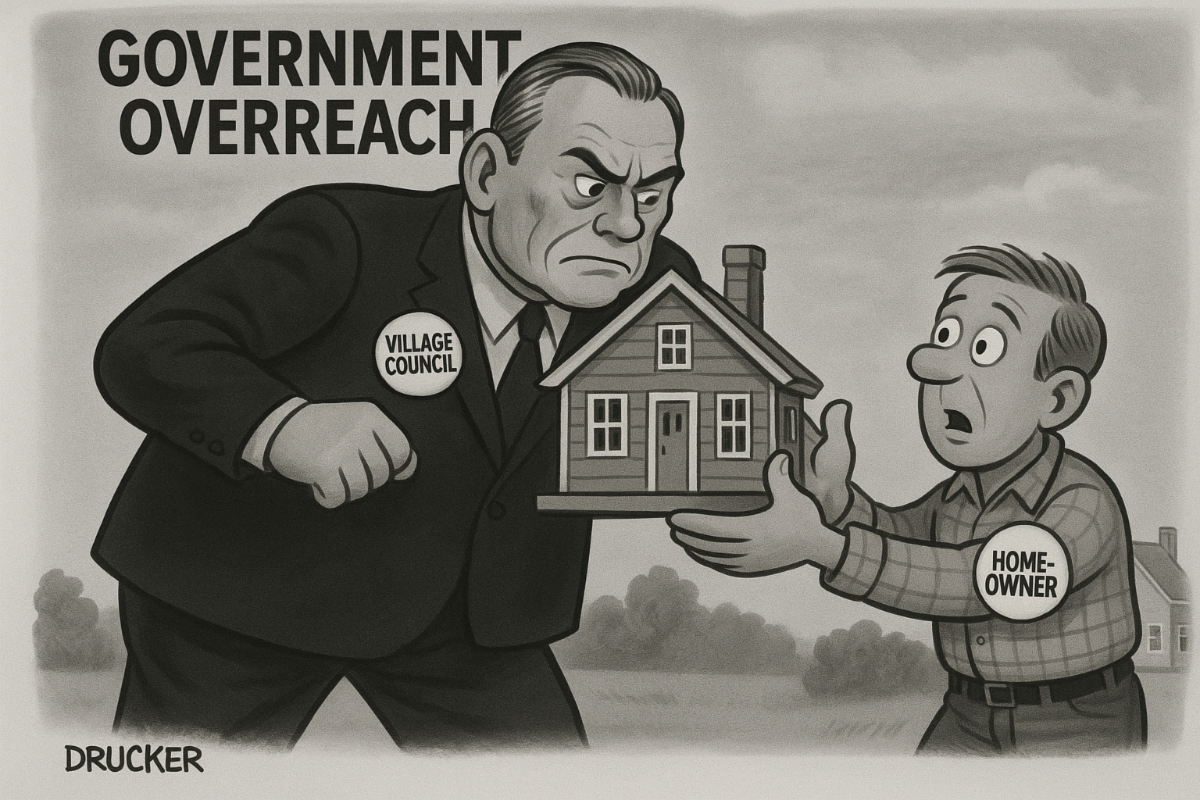
First the Lakefront, You Might be Next
Winnetka's restrictive bluff ordinance isn't really about lakefront safety -- it's a precedent for eroding every homeowner's property rights.
Government oversight ... or overreach?
We know that the ham-fisted, steep-slope -- aka, the bluff ordinance -- that only hurts lakefront property owners seems very niche.
It looks like an isolated issue, affecting one small part of our community, that should just throw money at a problem and go away.
But we can't make this go away.
Not everyone connected with Our Town Winnetka has lakefront property. Some do, some don't.
But as a matter of principle, we share a deep concern about the Village Council's posture toward private property rights.
Village Council M.O.
The real issue isn't about the bluffs. It's not about the waterfront, beaches, housing additions or any other kind of infrastructure. It is not about wealth or status, and it certainly isn't about public safety.
It is about the erosion of our property rights.
Not just lakefront property owners', but everyone's.
We are witnessing a new, dangerous precedent: without explanation or supporting data, the village council can quietly revoke your right to improve, secure, or alter your home.
That's the issue. And why it matters to you, wherever you may live in our community.
What the Village Council has done to homeowners on the lakefront, now it has precedent to do so throughout the village.
This is how government overreach begins.
How Winnetka's Bluff Ordinance Went Off a Cliff
When the Winnetka Village Council voted in February 2024 to pass its so-called steep slope or bluff ordinance, officials claimed it was about "public safety."
Well, who is against public safety? Not us.
Initially, the council proposed to undertake an engineering analysis of structures on the bluffs and share the findings. Lakefront homeowners largely agreed that was the proper route to take.
After all, the bluffs are private property, not open to the public, so there was no general awareness of what threat to public safety could possibly be posed by structures to which the public had no access.
Moreover, the village engineering office had to sign off on building plans ahead of construction, so it wasn't readily apparent to the homeowners what lapses there could have been.
Yes, a study was warranted.
Yet, no such engineering study was ever shared with the Lakefront homeowners if indeed it was done.
Instead, the council passed the most restrictive lakefront ordinances along the North Shore.
It was a spectacular case of government gymnastics—ignoring residents, bypassing required analyses and vaulting over established laws to enact one that diminishes home values across the village.
A Council That Didn't Listen
From the start, residents asked for transparency, collaboration, and real science.
At a September 23, 2023 study session Homeowners asked for a working group or subcommittee; the Council declined.
By January 2024, when the ordinance was first heard, residents voiced alarm about how it would damage property rights and values.
On February 6, 2024, weeks before the supposed end of the study period, the Council passed the ordinance anyway.
The Cost of Overreach
The economic fallout is enormous. It has triggered litigation in which 47 lakefront homeowners assert the village their instantly diminished property values by reducing usable land, simultaneously shrinking Winnetka's tax base.
The residents' lawsuit was dismissed last week for failing to show damage done by the ordinance.
The plaintiffs, however, say they have new evidence to support their claim and are likely to pursue further litigation -- which will cost Winnetka Taxpayers more money to defend.
A Slippery Slope
Ironically, it's not erosion of the bluffs that should concern Winnetka residents.
It's the erosion -- the slow corrosion -- of our property rights.
If the village can micromanage the development of some residents' houses when no public safety or health issues are at stake, it can do that to all residents' homes.
Where will it stop?
And we've seen this before.
For example, residents ask the council to make science-backed, cost-effective decisions about our energy policy. Instead, they re-upped with IMEA 10 years early.
We've seen the council gather data, proposals and plans for the Post Office site -- for nearly two decades -- yet, only to default to inaction.
When it has data, it doesn't act.
When it's ill-informed, it pounces.
Which leaves us with only one question:
Not what's next, but who?
Reminder: Town Hall Tonight
Your opportunity to have Your Voice Heard
- Skokie School Auditorium
- Doors Open: 7:30
- Meeting: 8:00pm - 9:30pm
- Voting: 8:00pm - 9:00pm
- Please bring a Valid ID