Winnetka Asked for More. The Council Isn't Listening — and It Will Cost You.
For twelve years, residents have asked for a real destination on the Post Office site. The Village's own open house said it again. Now the Council is paying $79,890 to sell the smallest plan on the table, one taxpayers would have to subsidize.
December 1 · 7 p.m. · Village Hall
The open space ordinances return that night, and 512 Chestnut is on the map. Write to contactcouncil@winnetka.org before then. Background: OTW's Open Space Resource Center.
On November 5 the Council approved a $79,890 contract, without competitive bidding, to find a development partner for 512 Chestnut Street — for a one-and-a-half-story restaurant building beside a surface parking lot.
This is not what residents asked for. They asked for a destination.
Once again, Village Council leadership and a few members are not serving residents, and it will cost them twice: in the community space they asked for, and in money — far more than the alternatives.
Twelve years of input, ignored
Every time Winnetka has been asked about this block, it has said the same thing: make the heart of West Elm a destination.
- 2014. In the Village's citizen survey, 80 percent of residents supported redeveloping the Post Office site as part of the business district. Only 19 percent opposed.
- 2024. In the Caucus Council's survey, residents chose more retail and restaurants for the site over public open space. Only one in five wanted the parcel leveled and turned into open space.
- 2025–26. The Village's own online survey drew about 1,257 responses. Residents ranked a public gathering space first and more commercial uses second, with restaurants, shopping and cafes at the top. One of their main themes was making downtown “a true destination with unique shopping and dining, such as a boutique hotel.”
On housing, the survey was split. Yes votes were spread across several alternatives, while “no residential” stood alone. Added back together, 547 respondents ranked some form of housing first, against 570 who ranked none first. That is a village split down the middle, not a village opposed. Teska's summary presented it as opposition. That is simply wrong — and when this was raised with the Village in writing on June 4, the reply ignored the point.
Residents did not ask for a one-and-a-half-story building with two restaurants. Across every survey — 2014, 2024 and 2025 — most residents want much more.
What the Village's own open house showed
In June, the Village invited residents to vote on six concepts with stickers. One board asked them to pick their top two. Here is what it looked like at the end of one of the open houses:
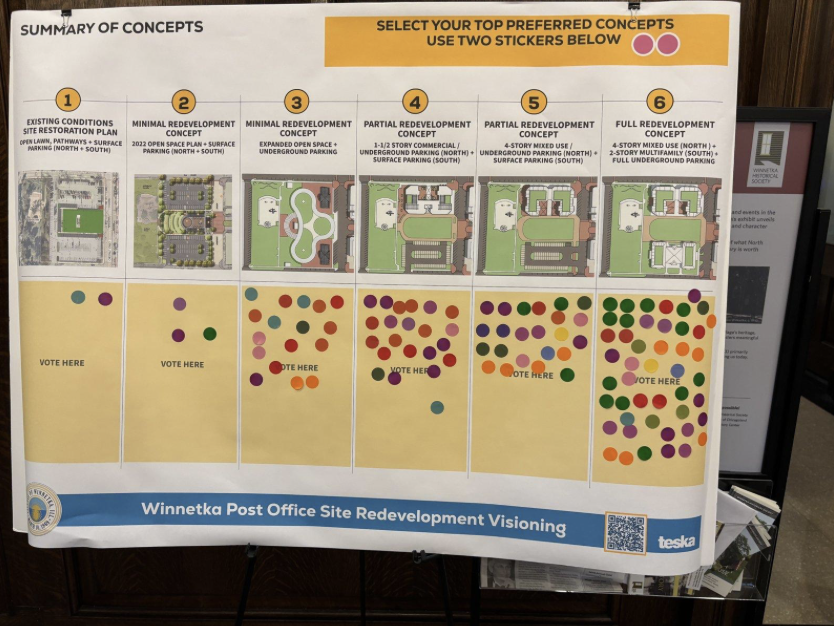
Concept 6 — full redevelopment with shops, homes and underground parking — drew about twice as many top-preference stickers as any other option. Concepts 4 and 5 tied for a distant second. The open-space-only plans barely registered.
Each concept also had its own board asking whether it was worth moving forward:
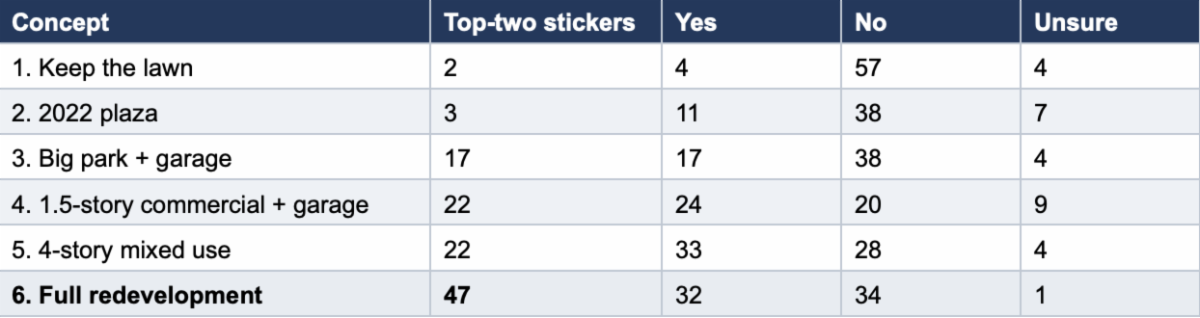
Keeping the lawn drew about 57 no votes to 4 yes. The plans that build something did far better — and the most ambitious one drew the most first choices.
How Concept 4, a restaurant and parking, got the nod
Teska's summary named Concept 4 the most favored by blending the online survey with the open house boards. On the boards in the room, it tied for second, at less than half of Concept 6's first choices.
Then the Council made it even smaller. The Concept 4 residents voted on in June included underground parking — the open house board said so in its title. In October, Teska recommended dropping the garage to save about $10 million, cutting public parking from 245 spaces to 177.
At the October 13 Council session, residents asked for a boutique hotel. So did Trustee Scott Myers. Trustee Tina Dalman called Concept 4 “a real missed opportunity” and asked the Village to “see what the market would present.” The Council directed staff to ask developers what they would build.
A month later, it hired a firm to sell one predetermined plan. And on December 1 it is scheduled to take up an open space zoning district that would place 512 Chestnut where commercial use is not allowed by right.
In other words: the Council decided first, then built the justification after.
No serious developer is waiting for this plan
The Village does not need OTW to tell it that Concept 4 is a hard sell. Its own consultants already have. They warned that a building this small means “limiting interest from larger developers,” is “unlikely to be built ‘on spec,’” and “will require public financing,” with a gap of $7.8 million to $17.8 million.
The Village's own concept boards from July tell the same story. They rated developer interest in Concept 4 low to medium. They rated Concept 6 the highest of all six — at roughly the same net cost to the Village.
Developers with a track record go where the numbers work. Concept 4 offers about 26,000 square feet of restaurant space, no homes and no hotel, on the best block in town, with a public subsidy built in. The Council is paying $79,890 to market a project that its own consultants say the market will not build on its own.
And it is not only a hard sell. It severely limits the opportunity to develop the land on the south side of the Post Office site later, if that opportunity presents itself. Two “halves” don't make a whole, given how this is going.
What Concept 4 costs you, every year
That public financing has to come from somewhere: a capital plan already stretched by other projects, Village reserves, or new borrowing. Borrowing is repaid by residents, through property taxes and fees. Suppose the Village borrows the gap over 20 years at about 4.5 percent:
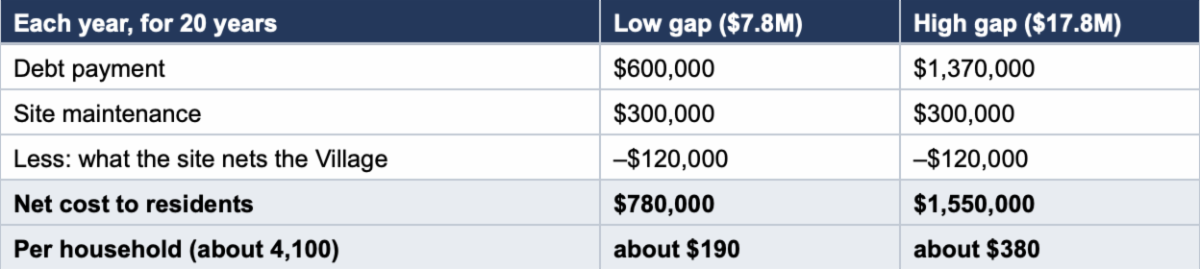
That is roughly $190 to $380 from every Winnetka household, every year, for 20 years — for a plan residents did not put first.
After the debt is paid, the maintenance bill keeps coming. By SB Friedman's own figures, the $120,000 a year the site would bring in would take about 65 years to repay even the low-end $7.8 million. This is the same Village that says it cannot yet fund repairs to its beaches and the Tower Road pier.
A bigger plan changes the math. For about the same public cost on the Village's own boards, Concept 6 puts 36 new homes and nearly 20,000 square feet of shops and restaurants on the tax rolls — paying the Village, District 36 and New Trier for decades, with diners and shoppers spending on West Elm every day. A full-site RFP would let developers show how much of the gap they can close themselves.
The choice is not between spending and saving. It is between subsidizing a small plan that pays little back and investing in one that pays the community back.
A decision for the next 75 years
The Post Office site sat stalled for 44 years. Whatever goes there now will shape West Elm for the next 75.
An anchor — restaurants, homes and maybe a hotel — brings people downtown day and night, fills the storefronts around it, and grows the tax base. A pavilion beside a parking lot does none of that.
Show us the data
No measure here is perfect. The open houses had no check-in, and it is not clear what safeguards the online survey had against duplicate responses. That is exactly why the Council should not lean on a single summary line.
Publish everything — and we do mean everything — to let residents see it, and then ask the market. The Village Council does offer a project website, but the full story leading to Option 4 is not on it.
Where OTW stands.
Winnetka has told the Village what it wants for this block in 2014, 2024, 2025 and again this year: a destination, with restaurants, shops, homes and real life downtown. We ask the Council to:
- Publish everything — the full results of both surveys, every open house board, and SB Friedman's analysis of all six concepts, with the method used to summarize them.
- Bid the whole site. Issue an RFP for the full block and let developers propose their best idea, including a hotel or mixed use.
- Take 512 Chestnut off the open space map on December 1.
Write to contactcouncil@winnetka.org before December 1, and come to Village Hall that night at 7 p.m.
Tell the Council what its own open house already told it.
Related: the Open Space Institutional Resource Center · Three Fights, One Habit, and a Bill That Will Come Due · 44 Years, Six Concepts, and the One Question the Village Never Asked · A Power Grab Masquerading as Preservation