The Bill Is Coming Due
Your Village bill is up 23% in four years, mostly through utility rates, not property taxes. On December 1, the Winnetka Village Council takes up that budget and the critical Open Space District — announced in last week's email, below the holiday-lighting news.
Be there, be heard: Tuesday, December 1 · 7 p.m. · Village Hall, 510 Green Bay Road
The Council takes up the 2027 budget and the Open Space District the same night. Come and speak, or write to contactcouncil@winnetka.org.
If you are currently raising children in Winnetka, December 1st Village Council is your meeting.
That night, the Village Council takes up two issues that will affect your family for the next 20 years:
- One is a 2027 budget that raises what your household pays the Village, with rate increases already scheduled for every year through 2031.
- The other is a 'recrafted' Open Space District — that puts your kids' schools and parks under a new Village zoning label whose rules for development and improvement have not been written. New Trier, District 36, and the Park District have already told the Village NO! to the Open Space District.
Both come down to one question: should a Village that is behind on its own pipes, sewers, and roads be taking on more?
It's another property-rights grab by a Village that struggles to deliver.
Come to the meeting. Ask the Council to account for the budget, and tell it NO! to the Open Space District.
Picture a Winnetka family: parents in their mid-40s, two kids in District 36 or New Trier, a mortgage, and in some areas of our community, a basement that has taken water at least once.
That family will likely be here into the 2040s, so it will pay for every decision the Council makes this December on debt, reserves, pensions, and utility rates.
Every town taxes its residents, and Winnetka's aging infrastructure has to be paid for.
This article isn't about whether to pay. It's about how. Most of the new cost is arriving through utility rates, borrowing, and thinner reserves.
None of those is covered by the Village's tax-cap promise, and none shows up on your property tax bill. Residents should see the whole bill before the Council votes on it.
Your Village bill, by the numbers
Most residents judge the Village by its line on the property tax bill, which is about 11 cents of every property-tax dollar.
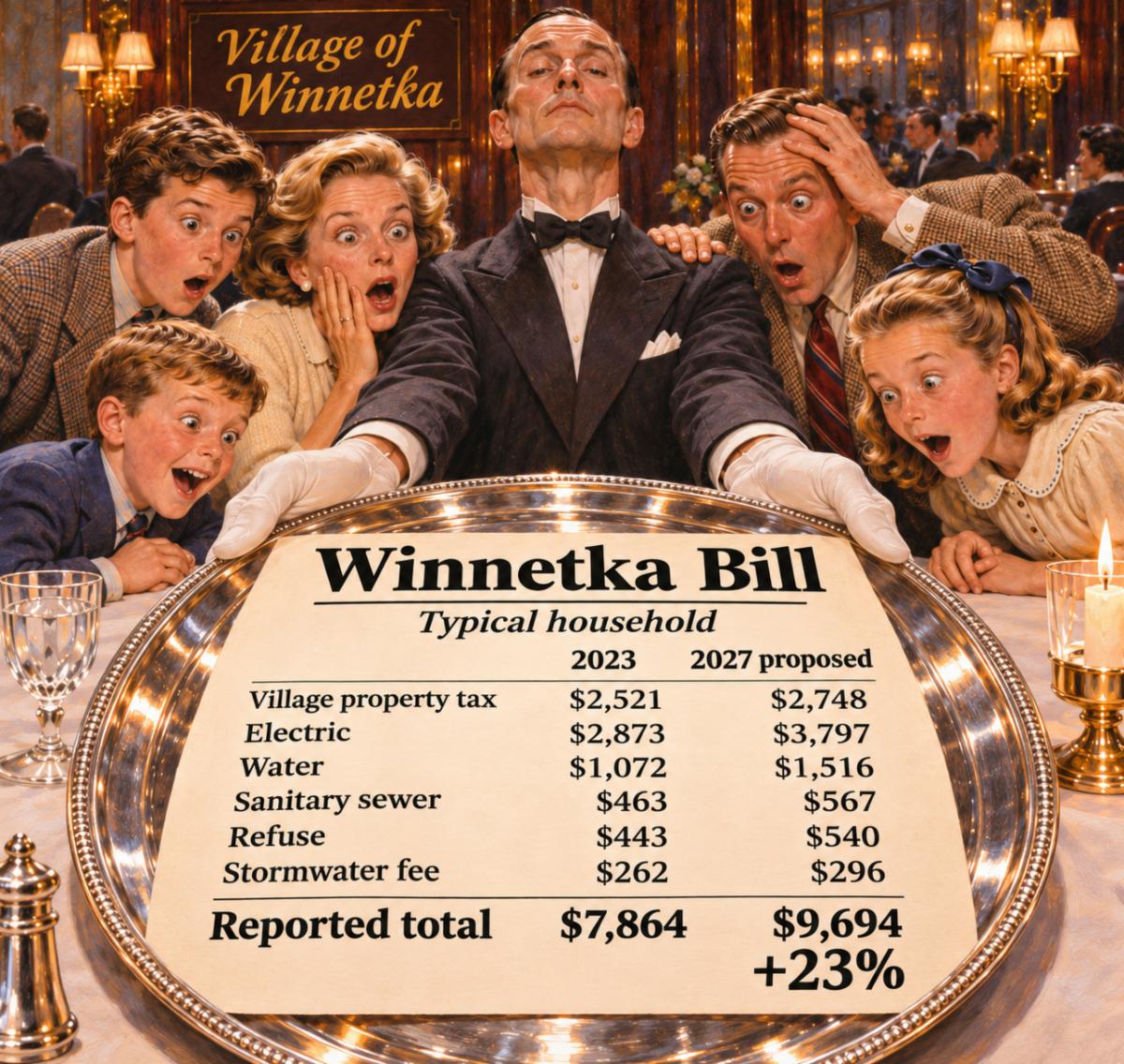
That line is no longer the main story. Here is the Village's own table for a typical household:
| Item (typical household) | 2023 | 2027 proposed | Change |
|---|---|---|---|
| Village property tax | $2,521 | $2,748 | +9% |
| Electric | $2,873 | $3,797 | +32% |
| Water | $1,072 | $1,516 | +41% |
| Sanitary sewer | $463 | $567 | +22% |
| Refuse | $443 | $540 | +22% |
| Stormwater fee | $262 | $296 | +13% |
| Total Village taxes and fees | $7,864 | $9,694 | +23% |
Source: Village of Winnetka, Proposed 2027 Budget, “Budget Impact on a Resident” (assumes a $25,000 total property tax bill and typical utility use). Total includes $230 in other taxes and licenses, unchanged. Percentages are OTW calculations.
Of the roughly $1,830 increase, about $227 comes from property taxes.
Yet, nearly 88% comes from utility charges (electric, water, sewer, refuse and stormwater), which now make up about 72% of what a typical household pays the Village.
The increases also keep coming.
By OTW's arithmetic, the planned rates take water about 40% higher and electric about 28% higher by 2031. Refuse rises 4.5% to 8% a year, and the stormwater fee goes up another 7.5% in 2027.
When the Village says it held the property tax increase to 2.7%, that is true, but it describes a small part of the bill.
Rate increases fall outside the 2005 tax-cap promise, and they rarely draw a crowd. Part of every utility bill, $1.86 million in “payments in lieu of taxes” in 2027, goes to the General Fund to pay for police, fire and administration.
The practice is common, and it is listed in the 2027 budget book, located here — all 587 pages of it.
It never appears on a utility bill, though, so most residents don't know that part of what they pay for water and electricity funds general government.
Add a new 1% home-rule sales tax, budgeted at $1.7 million for downtown, and the pattern is clear.
The cost of running Winnetka is rising through envelopes most residents never open, and notified in late Friday afternoon Village emails where the Council buries it behind 'Community Events.'
How we got here
For 25 years the Village's share of the tax bill rose 13.2% while consumer prices rose 85%.
That was real restraint. It did not make aging pipes, sewers and a power plant any cheaper, though. It postponed paying for them.
The five-year capital plan now puts the catch-up at $201.4 million, including:
- $52.3 million for electric
- $37.9 million for stormwater
- $30.5 million for water.
Most of that work is necessary, and none of it is new.
Who carries the rest
Paying for this work is not the problem. The repairs are overdue.
The problem is that four choices in this budget push the cost onto future bills without saying so, and those bills land on Winnetka's younger families:
- Debt. Outstanding debt rises from $9.8 million to a peak of about $56 million in 2033, on $58.2 million of new borrowing. That includes $15 million for the General Fund, which the plan lists without saying what it will buy. Borrowing for 50-year assets can be fair, because the people who use them help pay for them. But the payments run into the 2040s, so today's young families will make them, and they should hear that before the bonds are sold.
- Reserves. The General Fund falls from $28.2 million to a projected $17.8 million by the end of 2027. In the same budget, staff propose cutting the minimum reserve from six months of operating costs to four. The floor drops as the balance does.
- Pensions. The police and fire pension funds' actuary recommends assuming a 6.75% return. The Council chose 7.25%, which shrinks both the reported liability and this year's contribution. The funds are 83.4% and 76.4% funded. The shortfall doesn't go away. It waits for later.
- Unfunded out-years. The Village's own projections show the downtown revitalization fund about $10 million below zero by 2031 and the facilities fund about $3.4 million below zero. Neither has a stated plan to close the gap.
Planning is not building
In 2026 the Village budgeted $39.5 million for capital work and expects to spend about $20.5 million of it. Willow Road was supposed to start construction and didn't. The street program spent about $400,000 of $1.8 million.
A 2025 study found $10.3 million in sewer repairs needed to prevent basement backups, and it rated $6.3 million of that critical or high priority. The five-year plan schedules about $3.7 million. If your basement has flooded, that gap is the line item that matters most.
The lead the Village buried re: Open Space District
On November 20, the Village emailed residents its news.
The tree lighting came first, the menorah lighting second, and below both was an announcement that the Council will take up the Open Space District on December 1.
The district has been renamed the “Public Institutions and Open Space District,” and it takes in school, park, library, and forest preserve land.
We did not elect the Village to run the schools, the parks, or the library.
It's another form of land grab — read: Council overreach — that will slow down needed improvements by very capable boards that we separately elect and fund.
The revisions promise that sister agencies can keep using their land “under the same rules as exist today,” and that permitting requirements will not change “at this time.”
That last phrase is the point, because the rules come later.
If that were true, why do it? Because it puts the Village in the middle of every approval.
The Village struggles enough running its own repairs and generating revenue, to meet our shortfalls under its current President. See our last article on how they are handling the Post Office site.
In October, District 36, New Trier and Park District representatives told the Council they did not want their land in the district. The revision gives the district a new name. It does not take their land out of it.
So ask a simpler question. This Village delivered about half of its own capital plan last year and still has $6 million of critical sewer work waiting.
Why does it now want zoning oversight of land owned by the boards that run your children's schools and sports? It should fix its own pipes first.
STOP THE LAND GRAB. Tell the Council NO! to the Open Space District on December 1.
Five questions before the budget and OSI votes
- What will a typical household pay the Village in 2031, property tax and utilities combined, under this budget's rate schedules?
- What would pension contributions be at the actuary's 6.75%?
- Why lower the reserve floor in the same year the General Fund falls by $10 million?
- What will the $15 million in General Fund borrowing pay for?
- Why take on zoning oversight of school and park land before the rules are written, and before the Village has finished its own work?
Winnetka's Council wasn't reckless in the past. It was careful, maybe too careful, and that bill is now coming due, and young residents will pay for it.
The families who will pay it for the next 20 years deserve to hear that plainly, and to be asked what they want to buy.
Be there, be heard:
Tuesday, December 1, 7 pm. Village Hall. 510 Green Bay.
Related: Winnetka's $600 Million To-Do List — and What You'll Pay · Winnetka Asked for More. The Council Isn't Listening. · Open Space, Yes. Going It Alone, No. · the Open Space Resource Center